Thursday, May 29, 2014

On "The Grind"

This week, I was giving a presentation on chronic and respiratory illnesses including malaria, dengue, the common flu, and pneumonia. A major “treatment” of these illnesses is to rest, drink lots of fluids, eat a balanced diet, and maintain hygiene. As I am telling the women that they need to rest when they are sick, the looked at me like I was crazy. “Bea mi’ja, quien tiene tiempo pa’ descansar?” “Bea, who has time to rest?” I looked a little shocked and I continued. “I know you are all very busy caring for your families, but you can’t help your children if you prepare their food with a cough and poor hygiene. You also can’t help your children if you are too weak to get them ready for school.”

That afternoon, I realized that I had answered them rather curtly because in the back of my mind I was thinking, “I just got off the phone with my 23-year old best friend who works from 8am to 10pm many days a month and probably couldn’t tell you what “work-life balance” even means anymore. Another friend loves her job in “The City” but is always putting in extra hours on the polio or malaria account she works on regularly leaving the office at 7pm or later. And another is has been traveling all over the country for work and can’t seem to catch a much-needed break from the “grind.” But I should have withheld my judgment because here, even in a collectivist country, people are exhausted. Not to mention the added element of extreme heat they face while hand-scrubbing laundry, cooking outside on a three-stone fire, and running around after their kids. Life here is difficult, too, just in very different ways.

This is not a capitalist country, it’s a country where most people work in the informal sector, selling clothes or beauty products from magazines, painting nails for a profit on their front porch, asking neighbors for support, or finding American men to support them and their families. But even here, they perceive that they can’t catch a break. The capitalism grind we are so used to in America leaves us little time for rest, but so too, does the informal work sector that many Dominicans rely on. We all need a break and time to rest or these chronic illnesses I’m trying hard to prevent are gonna eat us all up!


Thursday, May 15, 2014

On quotes that keep me going


Quotes that get me through the hardest of days:

Caminante, no hay camino, se hace camino al andar.

“When each day is the same as the next, it’s because people fail to recognize the good things that happen in their lives every day that the sun rises.”

After a while you learn
the subtle difference between
holding a hand and chaining a soul
and you learn
that love doesn’t mean leaning
and company doesn’t always mean security.
And you begin to learn
that kisses aren’t contracts
and presents aren’t promises
and you begin to accept your defeats
with your head up and eyes ahead
with the grace of a woman,
not the grief of a child.
And you learn
to build all your roads on today
because tomorrow’s ground is
too uncertain for plans
and futures have a way of falling down
in mid-flight.
After a while you learn
that even sunshine burns
if you get too much
so plan your own garden
and decorate your own soul
instead of waiting for someone
to bring you flowers.
And you learn that you really can endure
you really are strong
you really do have worth
and you learn
and you learn
with every goodbye, you learn...
-Veronica Shoffstalf

All that is gold does not glitter,
Not all those who wander are lost,
The old that is strong does not wither,
Deep roots are not reached by the frost.
-FotR

“Living with integrity means: Not settling for less than what you know you deserve in your relationships. Asking for what you want and need from others. Speaking your truth, even though it might create conflict or tension. Behaving in ways that are in harmony with your personal values. Making choices based on what you believe, and not what others believe.”
- Barbara De Angelis


People will forget what you said. Peoople will forget what you did. People will never forget what you did. 
- Maya Angelou

Communities and countries and ultimately the world are only as strong as the health of their women.
- Michelle Obama

What would I do if I weren't afraid?

The only calibration that counts is:
how much heart people invest, how much they ignore their fears of being hurt or caught or humiliated. 
And the only thing people regret is:
that they didn't live boldly enough, that they didn't invest enough heart, didn't live enough. Nothing else really counts at all.
      
To live for only some future goal is shallow. 
It is the sides of the mountain that sustain life, not the top.


Monday, May 5, 2014

On bicycles and blue blooded bugs

Last week I bought a bike and it changed my life!


A volunteer couple who lived in a town called La Vigia only 23km away from me finished their service and left for America last week. We had talked about me buying the wife’s bike a while back but I had forgotten about it until she called to ask if I was still interested in the transaction. She promised me a few other surprises too, if I made the journey to their house on the Wednesday that they were leaving. So after a nice early morning run, I made my way by bus to their small little campo. I got off the bus and walked a nice and easy 4km from the into their town and cute two bedroom shack. They were busy packing up and getting ready to leave so I scored big! Richard and Cynthia outfitted me with snorkeling gear (two sets if you wanna come down and try one out!), a beach towel, a bike pump and repair kit, and a hotdog and ramen noodle/cabbage salad lunch. It was great to see their site and of course to get myself a bike and I’m only upset that I didn’t visit them earlier in my service, they were so close!

Around 1:30pm (prime sun time), I got on the bike and made my way back home, up a few hills and through a few towns. I made it to the town I work in on Wednesdays, Copey, and stopped at my favorite doñas house there for juice and a shower. When I rolled up to her gate sweaty and with a bike in tow, she exclaimed, “Bea, where’d that come from?” and I replied, “I rode it here from La Vigia!” They couldn’t believe I had actually ridden and not just strapped it to the front of a bus. They were equally as surprised to see that I hadn’t die in the heat or on the highway. My doña/grandma couldn’t stop telling all her neighbors what I had just done and I felt like a celebrity! It was a glorious day!

Now that I have my bike, it makes traveling around my town, visiting doñas and running errands so much easier. I don’t know how I survived so long without one. It even has a basket in the front for my loose ends and a basket on the back for carrying heavy loads. Well worth the expensive ($60) investment.

So last week was great. But as I’ve learned in Peace Corps, all good things come to an end (or so sang Nelly Furtado) and here's why: 

1. My bike got a flat.
Two muchachos were riding my new bike (without permission!) and they took it down to the beach where it got a flat tire...in the back wheel. EUGH! I called my uncle in Australia and he said, “Damn that’s a bitch to fix” and patiently described the process to me. I listened fully hoping I would be able to fix my own bike, but alas, after a challenging few minutes staring at the retro bike and it’s confusing chain parts, I called upon a passing neighborhood kid and sent him to fix it at the local tire shop.

2. I had a bug infestation.
It started raining last night and I ran into my room only to find thousands upon thousands of tiny little bugs flying around my room. I spent the better part of an hour killing them while skyping my bffl Emily. I’m sure she thinks I’m nuts. Our conversation was constantly interjected with exclamations like “ewww gross they’re spurting blue blood” or “ahhhh thousands” or “my floor looks like it has bug dandruff.” It was a mess to clean up this and I still twitch thinking about the bugs that landed on me constantly throughout that sleepless night.  

3. My feet are messed up.  
I’m pretty sure my feet will never be the same after this. I have and will forever have ingrown toenails, a wart and blisters on the bottom of my feet, a fungus on my left big toe (again!), and a painful to the touch third right toe. And then there’s the fact that they’re constantly dirty, sandy, itchy and cracking that accompanies the aforementioned problems. But...at least my host mom paints them with designs every two weeks so it’s not as obvious how nasty these little buggers are. Nothing like a beautiful pink and blue flower covering up a nasty ingrown!

Upon reflection, as I told a volunteer friend, I’m not being a very good PCV if the things that bother me most are the bugs, flat tires, gross feet and variables in projects I can't control. After all, this is what I signed up for, right? So I told myself to buck up, let myself miss how easy things are in America (sometimes), get over it and remember how insignificant these problems actually are. And I’m putting back on my motivation hat and charging full speed ahead this week!

Tuesday, April 22, 2014

On planting trees

Planting 30 trees seems like an easy task and in America it probably would be. You’d find a spot, dig the holes, plant the trees, give them water and be done with it. But not here. It's not mathematically precise, but if I had to guess, projects here are about five times harder, more complicated and more time consuming than an equivalent project would be in America. I knew this, so I started three weeks ago and for three weeks straight, I marched on into the mayor's office and ask that he help me plan the project down to the nitty gritty details. As I had predicted it would, the project turned into an ordeal! Here are all the variables we had to take care of:

Trees: which kind, who buys them, where do we find them, how do we transport them?
Soil: who has fresh soil to use, what do we put it in, how do we transport it?
Water: who will bring the water for the trees, will we continue to water the trees for days, weeks, months?
Labor: who will measure the space between the trees, when will we dig the holes and who will be in charge, who will help us plant, when should we meet and how often, who is responsible for brining the shovel, stakes, and other tools?
Goats: how do we prevent them from eating the trees? (this turned out to be the most important variable of the entire project!)
Fence: where do we find the wood to make fences to protect the trees from goats, who will make the fences, how do we transport the wood, who will provide said wood?
Other: what about food and water for us, who will provide tools, will the youth help, who takes pictures?

Our little Robles ready to be planted!

My green thumb at work

Bing, the casi mayor getting dirty!

Helper from the Ministry of Agriculture

Down they go!

My tree ready for her new home!

Men using machetes to make the fences to protect our babies from goats. 

The fences are in the works

No goats getting through this fence!

Mi matita!

Done! And it feels so good!

Finally, we had the holes dug and evenly spaced. Saturday rolled around and we still didn't have the wood we needed to make the fences and stop the goats from eating the trees. I had to call the mayor and tell him sternly I thought it was irresponsible of us to plant trees when our work would be destroyed by roaming goats. He assured me he had a plan. Additionally, only one of the fifteen youth I invited to the event showed up. Thankfully, we had some men from the Department of the Environment helping us and they were a huge help! 

It took us about 30 minutes to plant the trees once we loaded them from the vivero and dropped them in their holes but the rest of the day (8 hours) was spent creating wooden fence-like protection against the goats. Suddenly, my job turned from tree-planter to goat-herder. Already, within fifteen minutes of planting, two of the trees were completely destroyed. In the 200 meters we had planted trees, more than fifty goats began wandering in and out of the area eating our trees without a care in the world to the hard work we’d just put in. The men and I got to work protecting the trees and around 2pm, I had to excuse myself to head to my women’s meeting. I left them with water and snacks and they assured me there were going to finish the fences before they left for the day.

I left the area feeling proud, happy and content! This was the first project I could measure and see with my own two eyes. There was a tangible goal, a physical product, and a start and an end. I had done something. I was in Peace Corps euphoria!

However, apparently when I mentioned to the mayor it would be irresponsible of us to plant the trees without protection, he didn't seem to mind as long as he got his photo op of them going in. The men only had enough wood to make 16 fences for the trees, so that left the other 16 completely eaten within a day. I went back to check the work on Sunday and there was no evidence that we had even planted the other 16. It was extremely frustrating to see our work destroyed, but I suppose that only means we'll have to do another tree-planting day!

Saturday, April 19, 2014

On books and kale

¡Olé!

Last week was the most relaxing and a much needed tranquil break! Everyone had the week off for Semana Santa (Holy Week) and I stayed in Manzanillo and was cogiendolo suave (taking it easy). I slept in, cleaned, organized, ate sweet bean dish at all my favorite doñas houses, took a beach day, painted my nails, worked out, went to a merengue show with my grandma and extremely fashionable aunt and read three books.

One of the books I finished this week was Wild by Cheryl Strayed. It’s quite popular in America (so I hear) and I wanted to see what the fad was all about. Glad I did because it was a great read! Quick synopsis: Wild is a true story of one woman's journey hiking the Pacific Crest Trail from California to Oregon back in the 1990s. In documenting her travels, she simultaneously explains real-life problems like divorce, her mother dying, and a crumbling family life. Even though her life situation was/is completely different from mine, it was amazing to read how relatable her trail life is to my life here in the Peace Corps. PCT life is just like PCV life I suppose! A few quotes in particular have really hit home for me. Here’s my list of relatable quotes and a lil commentary on each one.
  • “My new existence was beyond analogy, I realized on that second day on the trail. I was in entirely new terrain. What a mountain was and what a desert was were not the only things I hadn't expected. I hadn't expected the flesh on my tailbone and hips and the fronts of my shoulders to bleed. I hadn't expected to average a bit less than a mile an hour...” 

Within my first month as a volunteer, I realized that my Peace Corps life is beyond analogy. What a culture is and what a volunteer does were not the only things I had my own expectations for. I hadn't expected to be living in a food desert, living teasingly close to comforts of America, never being alone, and constantly being constipated. I hadn't expected that my community projects wouldn't always work out as planned. And trying compare it “all” (my town, my job, my emotions, my challenges, the culture, the food, etc) to anything else in the world is impossible.

  • “I staggered north toward Kennedy Meadows, furious with myself for having come up with this inane idea. Elsewhere, people were having barbeques and days of ease, lounging by lakes and taking naps. They had access to ice cubes and lemonade and rooms whose temperature was 70 degrees. I knew those people. I loved those people. I hated them too, for how far away they were from me, near death on a trail few had ever heard of.”

What gets me is that not even 2,000 miles away, people are having barbeques, doing hot yoga, drinking good beer, eating kale, easily streaming Netflix, eating hot cheetos, having wifi everywhere, and experiencing climate controlled rooms. But then again, those same people don’t get coffee 24/7, rice and beans everyday, merengue/bachata music all hours of the day, to walk to work, Caribas platano chips, tostones, or the thrill of riding a motorcycle around town!

  • “I stopped in my tracks when that thought came into my mind, that hiking the PCT was the hardest thing I’d ever done. Immediately I amended the thought...Hiking the PCT was hard in a different way. In a way that made the other hardest things the tiniest bit less hard. It was strange but true.”
I wish someone had told me before I started how mentally difficult this job would be. It takes serious mental strength to get from day to day sometimes. And in the process, I’ve become my own biggest advocate, critic and motivator. It’s been the best exercise in finding power within myself. It’s a different kind of hard than I’ve ever known, but I suppose it can only make things I hope to do in the future that much easier.

  • “By the end of that second week, I realized that since I’d begun my hike, I hadn’t shed a single tear.”
I still haven’t cried hard and good here and it’s been over 8 months! I guess that means it’s going well?

  • As I walked, I didn’t think of those snowy peaks. Instead, I thought of what I would do once I arrived at the Kennedy Meadows General Store that afternoon, imagining in fantastic details all the things I would purchase to eat and drink...I pictured the moment when I would lay hands on my first resupply box, which felt to me like a monumental milestone, the palpable proof that I’d made it at least this far.”

 This quote resonates mostly because I spend time picturing the moment when I will lay hands on my next care package, which feels to me like a beautiful godsend, especially when it contains some combination of almond butter, Orbit gum, chocolate, Samoa Girl Scout cookies, dried mangos, chapstick, Reach mint waxed floss, new shirts, granola, nuts, fresh underwear and love notes.

  • “I spent hours in a half-ecstatic, half-tortured reverie, fantasizing about cake and cheeseburgers, chocolate and bananas, apples and mixed-green salads, and more than anything, about Snapple lemonade. This did not make sense. I’d had only a few Snapple lemonades in my pre-PCT life and liked them well enough, but they hadn’t stood out in any particular way. It had not been my drink. But now it haunted me. Pink or yellow, it didn’t matter. Not a day passed that I didn’t imagine in vivid detail what it would be like to hold one in my hand and bring it to my mouth. Some days I forbade myself to think about it, lest I go entirely insane.

For me, it’s not Snapple lemonade, but more a combination of the things I can’t have. Kale enters my mind a lot, as does spinach. And iced tea and iced coffee. And as she remarks, some days I forbid myself from even thinking about American pleasures, lest I go insane. It’s the worst when I’m talking on the phone to my momma and she’s munching away on something so I go ahead and ask, “what’s that you’re eating over there?” and she’ll reply “oh, sorry honey, it’s a caramel from Trader Joes” or “it’s just a kale salad dad’s making.” It’s torture! And the snapchats yall send of delicious meals...rude! 

  • “As difficult and maddening as the trail could be, there was hardly a day that passed that didn’t offer up some form of what was called trail magic in the PCT vernacular – the unexpected and sweet happenings that stand out in stark relief to the challenges of the trail.”

Yes, the Peace Corps is challenging and frustrating a lot of the time, but it’s also so much fun and so beautiful that I get to experience a new culture, live here, make friends here, hang out on porches, work with youth and mothers, and just be here. Every day, month, project, and experience is a net positive even if the accumulation of its parts comes with negatives.

  • “The PCT had gotten easier for me, but that was different from it getting easy.”

I’ve taken to writing in a journal and when I reflect back on entries from months ago, I can see how far I’ve come and grown and that’s been inspiring to me and truly powerful. And looking forward I see how much there is left to do, and think to myself than in one month, two months, six months, I’ll be looking back on today thinking how much more satisfying it will become. In 8 months here, certain things have gotten easier. Like the food, and the bugs, and the lack of water and electricity. But it is far from easy – a word I would never use to describe being a PCV. It’s been a combination of challenging, rewarding, satisfying, infuriating, miserable, amazing, inspiring and tough – but never easy.

  • Thank you, I thought over and over again. Thank you. Not just for the long walk, but for everything I could feel finally gathered up inside of me; for everything the trail had taught me and everything I couldn’t yet know, though I felt it somehow already contained within me.”

I suppose it’s too soon to know what this experience has taught me, but I do know that everyday, being here teaches me something. I’ve been keeping a journal (thanks to Carolyn and Roy, who sent me down here with plenty of Moleskins!) and will hopefully be able to reflect in time on the experience and the lessons learned. But I do not that there is something here invaluable that I will take away in the end. Too hard to put a finger on it just yet, or maybe I never will, but it’s here with me!

¡Nos checkeamos!
B

Monday, April 14, 2014

On politics, palaces and McDonalds

¡Buenos días!

I love politics. From knocking on doors in support of a candidate I love to reading about the laws passed in my home state of Idaho and in the capital DC, I eat up what most people scorn, mock and complain about. That part of me hasn't gone away, but I haven't had the opportunities to get my fingers wet in the pool of Dominican politics just yet. Until now! 

Last week I got a confusing phone call from the mayor of my town and some political bigwig from the capital inviting me to a meeting about promoting volunteerism in our town. I went to the meeting with my mayor and a few other youth and suddenly I had signed myself up to be the "consultant" for a trip to the capital for a national youth leadership conference with 75 youth from towns along the Haitian/Dominican border. 

he conference was organized by the Director of the Border, a politician from my town of Manzanillo and the idea was to train young leaders and unify a national organization of volunteers who will strengthen the border with talent and community service. Why? The seven provinces along the border are the poorest and least invested in area in the country. Additionally, there is a large migration of youth away from the border, and those who are left behind are largely uneducated, illiterate, and poor. Supposedly this conference will be part of the solution to keep smart and engaged youth in their hometown. 

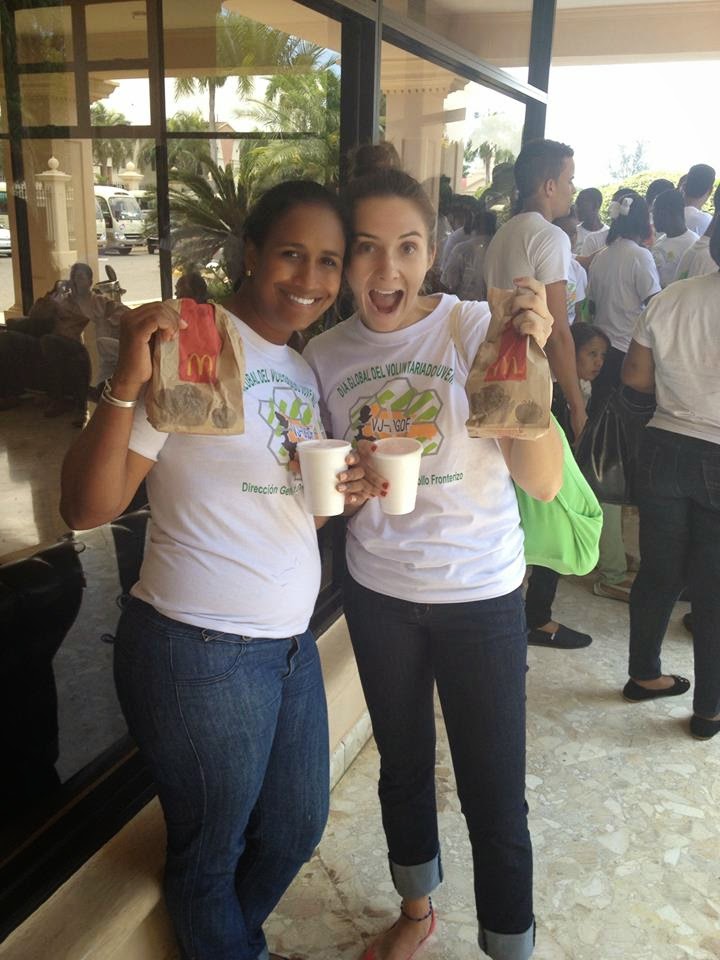
In three days, we visited the Supreme Court, DR Congress, attended panels with Senators and other elected officials, and toured the National Palace. For some youth, these were the first three days they had ever spent in the capital, and for some the first time they had left their small campo. They were snapping pics left and right and doe-eyed with all the "important" things we saw. It was really moving to experience this "big deal" with Dominican youth who rarely (if ever) have opportunities like this. I was impressed. But for a conference run by the government, it was surprisingly unorganized. There was no agenda, things just started when they started and ended when we got through the guest presentations. There was a camera man following us around all week and the director of the conference explained it was to show "the wonderful work of our government" (aka propaganda materials). We also prayed a lot and although I understand there is no separation of church and state here like in the US, it was incredible to see how much religion infiltrates and affects government. By far the best/randomest part of the trip was the free McDonalds they gave us at the end of our tour of the National Palace that some kids exclaimed "only the government could afford to give us McDonalds!" 

But now, how do we take back all the information we learned over three days? Engaging youth in Manzanillo and trying to promote "volunteerism" isn't something that's very cool or popular or even heard of. In a developing country where the majority of youth are married with children by age 20, it's hard to promote and excite them about helping their communities. What's in it for them? 

I've been reflecting a lot on where the drive to serve comes from. How did I get it? Why don't others have it? By no means have a conducted thorough research in this area, but I do know volunteering isn't entirely selfless. I started volunteering when I was 13, first for political campaigns and soup kitchens and then for youth projects and community cleanups. I don't know why I first thought to get involved (I think because my now mentor/close friend/ex-State Rep. Wendy Jaquet asked me) but part of me continued because people told me it would help me in the future. What kind of future, I didn't know, but I knew that I had some kind of future to get to. I can't lie and tell you a part of me didn't keep doing community service for the recognition it seemed to bring in the form of compliments, awards and prestige and the promise of "getting into college." But why did I keep doing it in college and to start my career which I suspect will include many more years of service? 

I still don't quite know, but I do know that if I've never finished high school, have two kids, will most likely never go to college, live with my mom, look for money from older men, and have low self-esteem, of course I would rather be drinking on a Friday night than planting a tree for some vision of a healthier planet I can barely grasp. And if I'm a high school student from a poor family without resources to send me to college and my parents are largely absent in raising me or call me stupid often, where will I find the motivation to do anything but escape my misery in socializing with my peers on Facebook? The answer is you wouldn't. But does encouraging and empowering youth make the difference, does telling them enough times that they have a future and can go to university, start a career, and go big places help? I hope so, cause inspiring and empowering seems to be 50% of my job! 

So volunteering doesn't happen much here, but where do the people who do help get their passion for service? In my town of 9000, I certainly don't know everyone, but I pretty much know everyone who attends community meetings, organizes parades for Independence Day, solicits donations to provide backpacks and toothbrushes to school children, motivates others to help plant trees or clean the beach and serves Manzanillo in various ways. Sadly, the people who participate can be counted on two hands. 

I don't have enough evidence to say if this situation in my town is unique because many other volunteers have been very successful with their projects and have communities where everyone participates. But I'm stuck. With attendance in my groups seriously dropping, youth making excuses for not participating, women unengaged to become health promoters, and my past two project partners shirking on their responsibilities, there is little I can do as a single person to motivate an entire population. So that's why I was so excited for this conference in the capital. I believe that with new tools and help from youth who attended, we will be able to work together to strengthen the network of volunteers that already exist and use them to help me motivate and organize a project or two in my own community. I just hope that somewhere and somehow I can find where the drive to serve ones community comes from and inject a healthy dose of it into Manzanillo.

Thanks to all of you who've encouraged me to keep serving others, I wouldn't be on this path, wherever it leads, without your support!

Xoxox, 
B

Friday, April 11, 2014

On a fancy capital tour

This week I was offered a spot on a Dominican youth tour of the capital. I went as an advisor and was able to experience first hand how the government works here. It was enlightening and inspiring to be here with youth who have so much potential and will be the future of this country. We had a blast!

Me at the desk of the Director of the Border with a nice pic of President Danilo Medina behind me
1 of 3 trail courts in the Supreme Court, notice there are only 5 seats
Inside the Supreme Court

Presenting a flower arrangement at the monument of the three fathers of the DR
Wouldn't be a government-sponsored conference without staying in a Catholic retreat center
Free McDonalds after a tour of the National Palace 
DR National Palace
Me with famous bachata singer, Raulin Rodriquez. Why the dark glasses at 11pm?
President Bronwen about to take a snooze in her royal chair
The Voluntariado Juvenil in the National Palace in one of the main salons

Post Panama: Lesson 1

It’s been 2 months and 13 days since I closed my Peace Corps service. The experts call this the “reintegration” phase and remind us that i...